From $100K to $1,000,000+
Monthly Revenue
A 20-month Shopify SEO campaign that turned a 6-figure store into a 7-figure monthly revenue machine — driven by topical authority, keyword scaling, and a compounding organic strategy that national brands couldn't outrun.
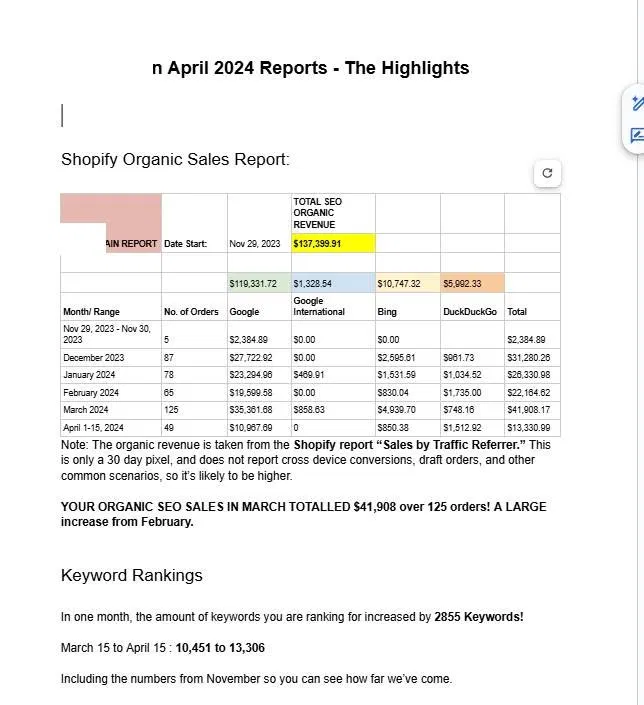
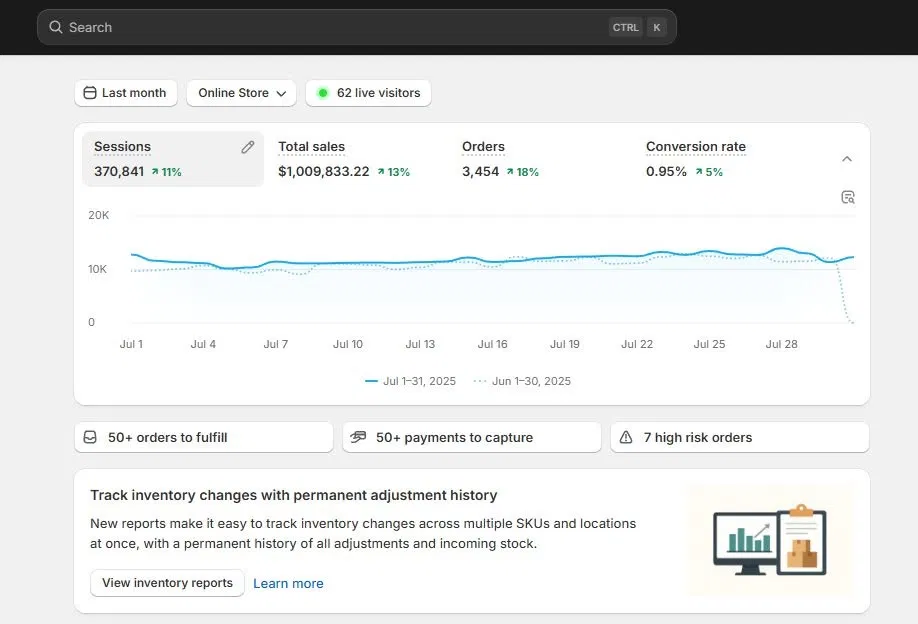
Left: Organic SEO report showing early traction — $41,908 in organic revenue from SEO alone in March 2024. Right: Shopify Analytics July 2025 — $1,009,833.22 in total monthly revenue, 370,841 sessions, 3,454 orders. Client name withheld under NDA.
"I still remember doing their very first report. Back then, they had around $100K+ in sales. Now? They've become an absolute beast. Just goes to show, SEO is never an overnight process."
Month 1
The store was already generating revenue through paid and direct traffic — around $100K+ in monthly sales. But organic search was almost entirely untouched. No keyword strategy, thin product page content, no content clusters, minimal internal linking. The SEO campaign started with a full technical audit and keyword mapping across the entire product catalog.
Months 2–4
Resolved critical crawl issues — duplicate content from Shopify's default URL structure, missing canonical tags, slow page speeds. Product titles, meta descriptions, and H1 structures were rewritten across the catalog using buyer-intent keyword data. Category pages were rebuilt with proper hierarchy, schema markup, and optimized introduction content. Internal linking was restructured to flow authority from high-traffic pages into priority products.
Month 5
March 2024 was the first clear signal that the foundation was working. Organic SEO revenue alone hit $41,908 across 125 orders — a large jump from February. The SEO organic report showed Google, Bing, and DuckDuckGo all contributing, with the keyword footprint growing rapidly. From March 15 to April 15 alone, the store gained 2,855 new ranking keywords — moving from 10,451 to 13,306 tracked keywords in a single month. This was the compounding effect beginning to take hold.
Months 6–12
Content strategy shifted into full execution — topical clusters built around core product categories drove informational and commercial keyword rankings simultaneously. A white-hat link building campaign targeted niche-relevant editorial placements, accelerating domain authority. Sessions climbed month over month. Organic was no longer supplementary — it was becoming the dominant traffic channel, consistently outperforming paid on a cost-per-order basis.
Months 13–20
By July 2025, Shopify Analytics showed $1,009,833.22 in total monthly revenue, 370,841 sessions (↑11%), 3,454 orders (↑18%), and a 0.95% conversion rate. The store that started at ~$100K monthly had crossed the $1,000,000 monthly milestone — a 10x growth in revenue over 20 months. This didn't happen in a single campaign push. It was the compound result of 20 months of consistent technical fixes, content execution, and link authority accumulation working together.
The store was already profitable — $100K+ monthly from paid channels and word-of-mouth. That's a real business. The challenge wasn't survival, it was unlocking the organic channel that was sitting completely idle. Paid traffic has a hard ceiling — every order costs money. Organic compounds. But getting from zero organic presence to dominance in a competitive e-commerce niche takes time, depth, and patience.
The technical state of the Shopify store at the start reflected what most Shopify merchants deal with: duplicate content across product variants, Shopify's default URL structure creating crawl inefficiencies, thin category descriptions, no content strategy, and a backlink profile that was too thin to rank for competitive commercial keywords. None of these are quick fixes. Each required systematic execution.
The most important constraint: SEO doesn't pay dividends immediately. The first three months showed minimal organic traffic increase. Month 5 was the first real signal. Month 20 was $1M. The client needed to trust the process — and the data from the early SEO reports gave us the ability to show compounding keyword growth even before the revenue reflected it.
Shopify generates duplicate URLs for product pages across collections (e.g., /products/item AND /collections/category/products/item). Without proper canonicalization, Google splits ranking authority between both URLs — meaning neither ranks well. Implementing canonical tags correctly consolidated all link equity onto the primary product URLs. This alone improved crawl efficiency and stopped Google from indexing thousands of duplicate pages that were diluting the site's authority.
Category pages were the biggest untapped opportunity. Each one received a proper H1, keyword-optimized introduction paragraph, FAQ schema, and breadcrumb structured data. These pages target high-volume commercial keywords and funnel traffic into the individual products beneath them. Rewriting even 10–15 category pages with correct targeting generated the first visible organic traffic increases — appearing in Search Console data within 6 weeks of the rewrites going live.
Early in the campaign, revenue hadn't moved much yet — but keywords were growing consistently. From March 15 to April 15, 2024 alone, the store added 2,855 new ranking keywords (10,451 to 13,306). This is the leading indicator that predicts revenue growth 60–90 days later. Tracking keyword footprint expansion gave both us and the client confidence that the strategy was working before the revenue data caught up with it.
Canonical tag implementation across product and collection URLs, crawl budget optimization for large catalogs, Core Web Vitals improvements, XML sitemap cleanup, and Shopify-specific pagination fixes. Ensured Google indexed the right pages at the right authority level.
Rewrote title tags, meta descriptions, and H1s across the full catalog using buyer-intent keyword research. Built unique, keyword-rich category descriptions with FAQ sections. Optimized image alt text throughout. Every commercial keyword mapped to a specific landing page.
Rebuilt the internal linking structure to pass PageRank from the homepage through category pages into priority products. Keyword-anchored internal links from blog content into commercial pages. Priority products received disproportionate link equity through strategic placement.
Built topical clusters around each product category — covering informational, comparison, and buyer-intent keywords at every funnel stage. Blog content drove top-of-funnel traffic that converted into product page sessions via strategic internal links, generating revenue from informational searches.
Niche-relevant editorial outreach targeting product review sites, industry blogs, and content publishers. Every backlink acquired was contextually relevant with real traffic — no link farms or PBNs. Consistent link velocity over 20 months built the domain authority needed to rank competitive commercial keywords.
Product, Review, BreadcrumbList, Organization, and FAQ schema implemented across the store. Rich results in SERPs improved CTR from existing rankings — more clicks at the same position means more revenue without needing to rank higher. Compounded every position gain made by other optimizations.
Peak monthly revenue — July 2025. Up from ~$100K at campaign start. 370,841 monthly sessions, 3,454 orders, 0.95% conversion rate. 20 months of compounding SEO execution.
| # | Metric | Nov 2023 (Start) | Jul 2025 (Peak) | Change |
|---|---|---|---|---|
| 01 | Monthly Revenue | ~$100K+ | $1,009,833 | ~10× |
| 02 | Monthly Sessions | Low organic baseline | 370,841 | ↑11% MoM |
| 03 | Monthly Orders | Paid-dependent | 3,454 | ↑18% MoM |
| 04 | Organic SEO Revenue (Mar 2024) | — | $41,908 | 125 orders |
| 05 | Keyword Footprint (1-month gain) | 10,451 keywords | 13,306 keywords | +2,855 |
Revenue data sourced from Shopify Analytics. Organic SEO revenue from Shopify "Sales by Traffic Referrer" report (30-day pixel — actual figures likely higher due to cross-device and draft order exclusions). Keyword data from Ahrefs rank tracker.
Ready to build your organic revenue engine?
$1M months don't happen from paid ads alone. SEO compounds — and the best time to start is before your competitors do. Let's map your store's organic potential.